






First off, what’s been the plan post-football for you – what’s next?
I’m farming now here in Florida. My family in Southern Spain were farmers – they farmed avocados and fruit. Now I’m here in Homestead, Florida – I bought a bunch of property with fruit trees and sell them to restaurants and also do import-export as well. Farming in the United States is very different – you have to think outside of the box to succeed.
People often discuss the difficulty in adjusting to post-military and post-football life, and you did both a number of times. How were you able to do so – and how does your military transition compare to football?
It’s a generic theme for players. On the whole players don’t really think about it while they’re playing – they think about Super Bowls. Leaving the military – that was the hardest thing I ever had to do in my life. No routine now – no uniform – now my uniform is Old Navy!
But it taught me the main theme – to find a purpose and work hard for it. It’s difficult to be amazing as a football player then be amazing at something else. It all comes down to working hard. The Pounceys have been able to do it with their liquor business. You have to treat it like a different matrix. When you play football you think all everyone wants to do is talk about you. You need to have a different worldview now.
A lot of people liken football to the military – how did that military experience help you as a player? In terms of helping composure, when facing combat and earning things like a Bronze Star Medal, did that make what you face in football easier to navigate?
In football you’re not worried about dying- you worry about getting fired every snap. And you don’t worry about being fired in the Army. The military isn’t hard- you do what you’re told to do and put one foot in front of the other. It’s about mass averages – they need the average person to do what’s needed.
In the NFL they are all elite athletes. There you’re nervous about fucking up for different reasons. When you’re in a helicopter about to land, you’re scared an RPG might hit you and that would be your last thought. In football you’re more worried about that next play.
But the principles I learned in the military – hard work – I wanted to be like an Airborne Ranger of football. I wanted to apply that same work ethic and be like a dog every day.
So many of those twists and moments to your career – was one most instrumental? And how were you discovered, having been a rugby player in Belgium?
No – I think everyone has moments, just like each person has different moments. It’s not like my dad was looking at me one day on a fourth and one and told me he loved me after I converted it and it changed my life!
I didn’t love football at first. I played rugby first – I loved rugby more. I loved playing wide receiver – but I didn’t love playing on the line of scrimmage as a lineman! It was harder and no one wants to get beat up every play.
I started playing because I wanted to fit into American culture. I saw that the football players all had their groups and hung out together in school. I wanted to be around those bros and make friends.
I used football for that and money. Few play because they want to put their body in harm’s way. Guys who play football do it for different reasons.
Your brother was a professional rugby player to correct? Were you both competitive with one another?
Miami was the 18th city we lived in – my parents moved around a lot. We were always competitive and played something wherever we went. We played rugby in Spain then in Belgium we went to an American high school. We called ourselves German Shepherds because we were good at everything. My brother was way more athletic than me but he stayed with rugby since he wasn’t born in the United States.
Of course we know about that transition to offensive tackle with the Steelers – did all of that versatility in college playing so many positions and rugby help you in that transition?
I played soccer the most. When you are in Spain there’s no other sport except soccer. In Pittsburgh you have the Pirates and Steelers and Penguins. But in Spain it’s soccer and more soccer.
I wasn’t great but it gave me the mobility in the lower legs – more than I think the average American gets. In Europe when two guys fight they kick each other. In America they throw punches. That’s because of soccer. It’s crazy how much soccer helped me with my hips and mobility.
Who in Pittsburgh helped mentor you most as a lineman and how did you make that adjustment so successfully?
When I first got to Pittsburgh Coach Munchak was focused mostly on the starters. They got most of his attention. Tunch Ilkin was covering the team then – he and Wolfley would show up at practice one or two days a week. Tunch showed me his technique – his Tunch punch – and gave me a DVD to watch. When I was on the scout team he’d watch and evaluate me. It made practice fun – like my dad was watching me.
If I did well and kicked Harrison’s ass he’d tell me and that boosted my confidence. Once I became a starter Munchak became a tremendous mentor to me. I would over-analyze my own play and get in my own head and complicate things for myself. He helped me with that. He had a unique way of coaching and I bought into his philosophy.
Marcus Gilbert and Kelvin Beachum too both helped me. Beachum was a student of the game. His body type wasn’t perfect for a tackle and mine wasn’t either due to my height. I learned from Beachum how to play using my advantages more and to take advantage of the other guy’s weaknesses. Beachum never saw me as a threat even though I was behind him on the depth chart.
Who were the toughest matchups for you, and why?
All the Cover 2 teams with good corners were the toughest. Like the Jaguars and Eagles. They had four-down rushers and when the corners are good the quarterback has to hold on to the ball longer to clear the zone – that gives those edge rushers more time. Then those edge rushers don’t care about the run. So these are the hardest games for any tackle.
Heard a lot of the players talk about the comradery on those Steelers offensive lines. What are some of there best off-field moments that come to mind for you?
The whole time we were laughing – from the moment we got in until we left. Tomlin was hilarious and Munchak was like a standup comedian. We’d laugh so much in meetings we couldn’t get work done.
Marcus Gilbert – he had the most contagious laugh. He’d put us all in a different mood.
What was it like teaching JuJu how to drive?
I think that story got overblown. I just took him to the DMV! I told him he couldn’t just Uber around the city and to practices. A lot of soldiers were bad at those driver’s tests. I felt as a Lieutenant it was my job to help them out and I did that with JuJu!
What about those rivalry games – any good memories from those?
The Ravens and the Jaguars – they were just other teams to me. The Ravens never had a great pass rusher when I was there. It was never tough for me particularly. Not the interior line – that was tough. That was physical.
They had Suggs – he wasn’t tough?
I matched up well with him and he was closer to the end of his career then. Guys like Mathis and Freeney – those are the guys you had to run on. They were crafty and had those good spin moves.
The Steelers and Ravens too – they had that unwritten rule that whoever ran the ball most was going to win. They were stubborn – they didn’t want to pass the ball. The Browns would come out and throw it and that made it tougher – now you’re behind and have to go against Myles Garrett. As a lineman when you throw 40 times, if you let up one sack that’s what people see -that guy celebrating after that one play.
How hard was it ending your career in Baltimore and what did you notice was the biggest difference between the teams?
It’s hard like it’s hard for any player, but I think it wasn’t as hard for me only because DeCastro, Pouncey, Ramon Foster -they had all retired. Moving wasn’t that hard for me – I did it 18 times growing up! I think it was good for my kids to experience that too and I wanted to play in Maryland – that’s where my wife was from. It was good to go and still play for a wining team.
Was it hard to be in the other side of the rivalry?
No – I had to remember guys like Woodson and Wormley played on other teams. In Europe you’d see a Portuguese player go play for Barcelona then mock the Portuguese team when they beat them. So being from Spain and seeing that, that idea of loyalty seemed bizarre to me. I was in it to make money.
What was difficult was the change in routines. We were laughing non-stop in our meetings in Pittsburgh. Now in Baltimore I had a new coach with a different personality. We did different drills that I wasn’t used to and it was harder on my body. But the city and team were amazing. It was similar to Pittsburgh – they took pride in their team and city and had tough practices. They didn’t go out to clubs and pretend to be famous. They were all cohesive and bonded well.
Harbaugh was an interesting human being too. I had an amazing year there and got to play familiar teams which was fun. I liked going back to Pittsburgh and seeing the rivalry from the other side.
Really, my whole career was like a dream. All those teams I played for from the Eagles and Cincinnati to Pittsburgh and Baltimore – they were all part of my NFL experience and it was amazing.
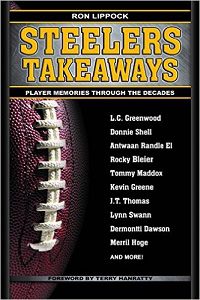
Read more by former Steelers via the book Steelers Takeaways: Player Memories Through the Decades. To order, just click on the book: